Showing posts with label POSTPUNK. Show all posts

Tuesday, September 29, 2026

We are in Kansas still

One of the retrospective embarrassments I have with Rip It Up and Start Again is The Embarrassment  - the non-appearance of the Kansas (post?)punk group and their terrific 1980 debut single "Sex Drive". 

But during the original postpunk era, I'm not sure I'd ever even come across the group.  Their name and their music did not reach our side of the pond. 

Not sure how they actually swam into my ken but eventually they did a few years ago. I became quite addicted to "Sex Drive". 


Particularly enjoy the unusual drumming from Brent Giessmann, which has a curious flappy yet powerful quality that really drives "Drive" along. Its placing in the mix adds to the unusualness, like the drum kit is on a promontory of the stage jutting into the audience, so it's right up in your face.

I read someone somewhere describing this song as pure American punk with nothing English about it at all. 

Ah, now I remember - it was while researching Still In A Dream, the grunge chapter. I was reading an early edition of Sub Pop when it was a fanzine. So it must have been Bruce Pavitt. He was going through that transition common in underground US music, from utter Anglophile Noo Wavism to full-throated Anglophobia. Hence describing The Embarrassment as "all-American rock, nothing to do with effete Anglo crap".

However to my ears the guitar on "Sex Drive" sounds distinctly early Banshees. As though at least one copy of Join Hands had reached a Lawrence, Kansas record store. 

B-side "Patio Drive" also superb. 


Apparently, the Embarrassment genre-tagged themselves as "Blister Pop", which is neat.

A valuable corrective supplement to  Rip It Up arrives with the publication of No Choice but Action: The Kansas Postpunk Revolution by Darren DeFrain and Francis X. Connor. It's out now on University of Kansas Press.


Release Rationale: 

The Embarrassment. Get Smart!. The Moving Van Goghs. Micronotz. Truck Stop Love. These weren’t outliers. They were the beating heart of a vibrant, self-sustaining cultural ecosystem pulsing through Lawrence, Manhattan, Topeka, and Wichita. With no industry infrastructure to lean on, musicians built their own: basements turned into venues, cassette culture fueled DIY distribution, photocopied zines became lifelines, and word-of-mouth grew into a network strong enough to launch bands onto national stages. Additionally, Black Site has produced an essential audio companion album that includes twenty-four tracks of bands featured in the book. No Choice but Action challenges the coastal narratives by positioning the Midwest as a creative epicenter, not a cultural afterthought.

At a moment when conversations about how creator economy and independent artist culture thrives, this book offers fresh insight, rigorous scholarship, and a narrative accessible to both scholars and general readers.

There is also an album accompanying the book, released this very day by Black Site. 


You can hear the comp here: https://ncba.bandcamp.com/album/no-choice-but-action

release rationale;

Kansas postpunk from 1978 to 1994 wasn’t just music—it was a lifeline, a defiance of the ordinary, and a community built from raw energy and unapologetic passion. In small towns and underground venues across the state, bands created a sound and a movement that refused to go unnoticed. For decades, the stories of those bands—their late-night gigs, road trips, DIY recordings, and the bonds they forged—lived only in the memories of those who were there.

The "No Choice but Action" book started as a way to capture that spirit before it faded. It began with interviews, old fliers, photographs, and cassette recordings unearthed from basements and boxes. As the stories came together, what emerged wasn’t merely a history book—it was a testament to the grit and creativity that defined an era. The book became a love letter to the Kansas punk scene, an attempt to preserve the voices of those who lived it.

But something was missing. As much as the words told the story, it was the music that brought it all to life. The idea of pairing the book with a vinyl record felt inevitable. Postpunk isn’t just read—it’s felt. The compilation you’re holding is more than an accompaniment to the book. It’s a revival of the sound and attitude that made Kansas punk unforgettable. 

We extend our heartfelt thanks to all the musicians, producers, and archivists featured on this album for their contributions to the Kansas punk rock scene. Your music not only defined a generation but also continues to inspire new audiences today.

We also acknowledge the support of Wichita State University, whose commitment to academic and cultural research provided the foundation for this endeavor, and more specifically, Joshua Smith, Gloria Esparza, Shaybree Haynes, Lucas Gill, and Joshua Cary for their assistance in the production of this album.

Finally, to the fans of punk rock—past, present, and future—thank you for keeping the spirit of this music alive. This album is a tribute to the DIY ethos, raw energy, and unrelenting creativity that defined Kansas punk rock.

We hope it serves as a time capsule, an invitation for further discussion, and a source of inspiration for generations to come.


Goodness, there was a whole documentary about the Embarrassment. But you'll have to watch it on YouTube as its age-blocked.


Ah, the guitarist Bill Goffrier went on to be in Big Dipper,  who I do remember from the Still In A Dream era. Quite liked the releases they had on Homestead but not as much as some other things on the label.   

Wednesday, October 16, 2024

Deconstructive Artwork


There were a bunch of other permutations - probably a tour poster.  Update 1/8/2025 here's a gig announcement advert


The cassette had a different wording, mentioning "cassette inlays" rather than record covers. 


When the compact disc was invented, they adapted the text again for that.

 And then there was this XTC Go 2 era rarity which Andy Miller posted not so long ago on a social medium


And this follow-up advert with pull quotes from reviews


All the handiwork of Hipgnosis, adapting here quite smartly to the New Wave way of doing things, dropping their proggy sub-surreal tableaux thing.

Made me start to look out for other examples of this and so far this is what I've found. 


"The Buzzcocks Range of Quality Goods" 


Then there was also the Fast Product angle. Here a disagreement about the artwork for Gang of Four's release is documented on the back cover, a gesture at transparency (Bob Last went with a different concept for the front cover).


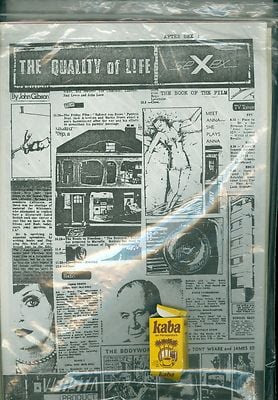
Last and Fast also put out some non-music releases that were playing with the idea of the commodity, packages filled with clipped out magazine images, pieces of orange peel (soon to rot) and other consume detritus. One called The Quality of Life, the other SeXex.


The idea of "product" being forefronted in the name Fast Product - this here is a commodity that you've purchased - a reveling in the fetishisable husk in which music reached consumers - is something Bob Last copied from New Hormones and Buzzcocks.


The tabloid newspaper packaging of the debut Public Image Ltd single also fits - as does the Vogue style glamour shots on the debut angle. 

Or indeed the very idea of presenting yourself as a Limited Company - the band as corporation.

See also British Electric Foundation. And to a degree The Tubes - at least for one album


Perhaps imitating PiL's we are a communications company, not a band idea, World Domination Enterprises talked about becoming a corporation, sparring with the kind of pollution creating multinationals they critiqued in song and protested with their busking tours outside huge corporate office buildings and government institutions involved in environmental destruction. 


Other exponents

Sudden Sway - Phil wrote a fascinating essay about Peterborough's finest some years ago.  The packaging element was nuts - wasn't one record some kind of board game? 


And I suppose the very first to make a stab at this was The Who with The Who Sell Out - although that was a parody of pirate radio, then synonymous with commercials and commercialism, rather than undergroundism as we'd understand it with the subsequent history of pirate radio. The people behind pirate radio in the Sixties were canny entrepreneurs, in favor deregulation, wanting the UK to be like America. Future Thatcherites many of them 

Subsequently lamely echoed by Sigue Sigue Sputnik with their attempt to have actual ads as opposed to pretend ones between songs on their album. 

Win - formerly The Fire Engines ( again associated with Bob Last, this time with his post-Fast label Pop Aural) - had a whole consume-us, we-are-shiny-baubles, fizzy-drinks to guzzle kind of thing going, which then became (as with Sigue) increasingly humiliated and desperate when no one wanted to buy their particular product.  But that was already there in the Fire Engines days too - "Get Up and Use Me", "New Things In Cartons", even "Candyskin" in a way. 

Pop as units of stimulation, "modern drugs", disposable buzzes, sugar highs. 


But there must be loads and loads more examples

There's a Brechtian term, isn't there? "Expose the device", I think.  

Bob Last was a theatre student and Brecht had a big revival in the 1970s.

The Who - it's from Warhol and Pop Art, presumably. 


^^^^^^^^^^^^^^^^^^^^^^^^^^^^

Some more recent things in this approximate zone


Imaginary soft drink / pop star from the PC Music squad


And further back in time, The Pop Tarts - American Pet Shops Boys with Baudrillardian hyperconformism / simulation pop elements - named themselves after a sugary treat and talked a fine talk about starting their own line of spin off products - truffles, fragrances what have you (this long before pop stars and rappers routinely diversified and turned themselves into brands). The Tarts were caustic about the pseudo-alternative rock of their day, R.E.M., the illusory concept of authenticity et cetera 

Frank Owen (oh think what I could have achieved if I'd had his motormouth pushiness!) browbeat the editors of MM into putting the Pop Tarts on the front cover, with - I think - exactly zero releases to their name at that time. 


Not sure if The Pop Tarts ever did any deconstructive artwork though, as I'm not sure they ever released a record.... 


And there was the whole U2-goes-pomo phase of Pop and "Discotheque" and Bono-as-McPhisto

They did a tour called Popmart and there was some kind of launch event or press release in an actual K-Mart. 


Never sounded less convincing or more ill-fitting than in this phase, U2.

Even Rattle n Hum was less undignified, and it was abjectly inapt and jive. 


It began with Zooropa, right, this postmodern / we-are-products-in-the-pop-marketplace era?

Whereas Achtung Baby did work, was a valuable loosening up and widening out of U2, after the pious roots-maneuver of Rattle "n' Stinks


After Pop, they had no choice but to rebuild their virginity and go back to their forte, their true lane, with "Beautiful Day" and whatever that album was called. 


^^^^^^^^^^^^^^^^^^^^^

Andrew Parker points out the Spiritualized packaging in the style of generic chemist's packet of tablets. Playing cleverly on the old Spacemen 3 idea of music-as-analgesic, "the perfect prescription" etc. 


Very clever - "may cause drowsiness"


Now I have this somewhere and I have a feeling I never even opened it, having exhausted my interest in the record with the cassette advance. Perhaps it's valuable? It's probably a bit bashed about in transit,  over the years, though.

The compact disc sealed up in a foil sachet like an actual tablet - love it.


The credits styled as pharmaceutical style information, active ingredients, dosage instruction, side effects, warnings etc is very clever 


Ed mentions Flipper's play on the generic, off-brand product lines in supermarkets, which was then - he says - ripped off by PiL (if true, perhaps fair enough given Flipper's debts to PiL)


The kind of generic product Flipper have in mind is specifically pharmaceutical - the own-brand medication sold by the likes of CVS and Rite Aid and Target. 

And so there is some proto-Spiritualized fun had with this idea on the record labels and the inner sleeve


Probably fancifully, some - Flipper themselves? I'm not sure - thought that Public Image Ltd  ripped off the Album idea for Album

I doubt it - I think maybe it's Virgin Records folk memory of XTC's Go 2

See PiL have the XTC style variants for different formats


However they messed up here I think, since "album" is not a format per see but a type of work, defined by its composition (usually if not invariably multiple tracks) and duration. The cassette and compact disc versions are also albums. They should have called it LP or Long Playing Record or maybe Vinyl LP for total specificity. 

Wouldn’t calling a release different things - Album, Cassette, Compact Disc - screw up your chart shop returns and chart position?

Did "Rise" come out as "Single"? 

Why yes it did!


And they even copied XTC with the label 


But what happened when the second single was released from the album? Was that also called Single? Or maybe Another Single. 

Nope they kept the font - and the sort of Sainsbury own brand style design - but they used the song title this time. 


I bought  the limited edition double-pack version, 2 seven-inches in a gatefold. I guess because "Rise" was included. Can't remember anything about "Home".


]
They missed a trick here - if they had done a couple of new tracks to round it out, they could have titled it EP or Extended Play.  Then again, per my comments above about "type of work" versus "format", maybe not. 


Flipper got their "own" back with this live album Public Flipper Limited

In a Sudden Sway like gambit, this album can be turned into a board game


Phil mentions Scritti with the 'how to make your own record' information and recording costs on the sleeves. Does he seriously think that Scritti just slipped my mind?  Me, who has been described as a Scritti-stalker!


The Peel Sessions EP (above) actually has the contract they signed with the BBC as the ground on which the demystification info is printed. And for utter transparency there is also a written account, on the left, of how the process went down with the Peel show (within the limits imposed by the BBC, which didn't allow them to discuss the negotiations). This is juxtaposed (on the right) with the ir own production costs for the vinyl EP.


On The Mekons Story, they have a friend of the band reading out snippets from their contract with Virgin in between songs... 

Desperate Bicycles fit in somewhere too.


Andrew Parker mentioned these Pop Art we-are-product style covers


nuddy horror attack (noo wave edition)

  Pin-up of the thickly thatched Jimmy Pursey, at a female reader's request, duly answered by the equal-opportunity musical newspaper S...